THE DUET HISTORY NEVER GAVE US: ELVIS PRESLEY & DOLLY PARTON SING “I WILL ALWAYS LOVE YOU” — AND THE STORY BEHIND WHY IT NEVER…
Introduction
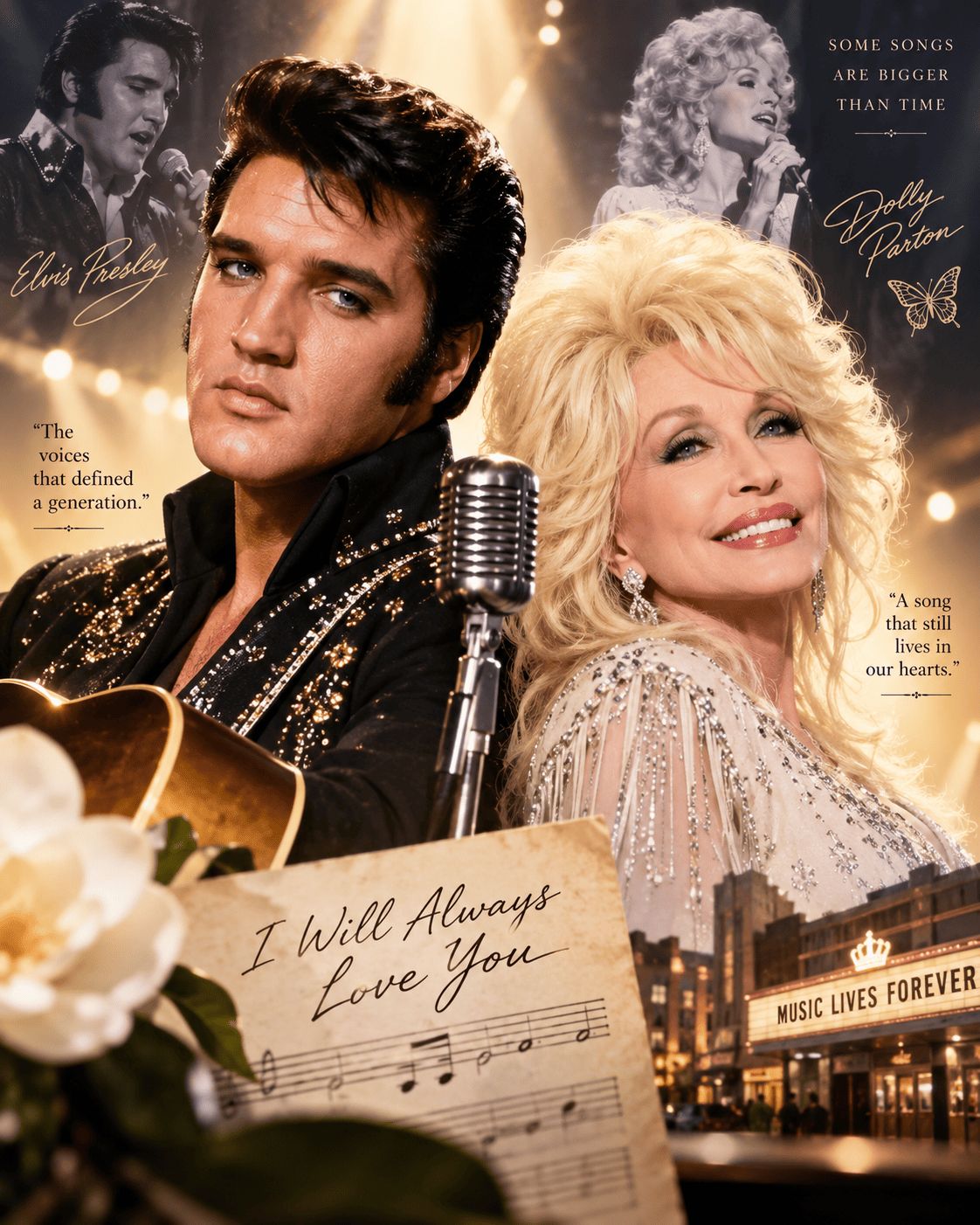
There are moments in music history that happened exactly as we remember them—and others that live forever because they almost happened.
Few imagined collaborations carry quite the same fascination as the thought of Elvis Presley and Dolly Parton standing beneath the same stage lights, sharing a song that would eventually become one of the most recognizable ballads in American music. Elvis, the commanding voice of a generation. Dolly, the extraordinary songwriter whose melodies could turn ordinary moments into lasting memories. And between them, “I Will Always Love You.”
But before the imagination takes over, there is one important truth: Elvis Presley and Dolly Parton never recorded this song together. There is no surviving duet, no forgotten television appearance, and no secret studio recording that can prove they ever sang it side by side. What does exist is something almost as fascinating—a real story in which Elvis reportedly considered recording Dolly’s song, a possibility that placed two extraordinary musical worlds surprisingly close to one another.
That is where this story begins.
Dolly Parton wrote “I Will Always Love You” during one of the most important transitions of her early career. After seven years working with Porter Wagoner, she was preparing to leave the professional partnership that had helped introduce her to a national audience. The song became her musical farewell: not an angry goodbye, but a remarkably composed expression of gratitude, sadness, independence and hope. Dolly’s own official biography describes the song as being inspired by her departure from Wagoner in 1974.
The song quickly demonstrated that it was much bigger than a farewell.
Dolly’s original recording reached No. 1 on the country charts. She later recorded it again for The Best Little Whorehouse in Texas, and decades afterward her song became globally famous through Whitney Houston’s extraordinary interpretation in The Bodyguard. Dolly’s own career eventually brought the song back into the country spotlight yet again through her 1995 duet with Vince Gill.
But somewhere inside that remarkable journey sits the Elvis chapter.
For years, Dolly has spoken about the possibility of Elvis recording “I Will Always Love You.” The story has become part of the mythology surrounding the song because it involved a decision that was deeply personal for a young songwriter: whether to give up part of the publishing rights connected to her own composition.
Dolly ultimately said no.
That decision is easy to look back on now and describe simply, because we already know what happened afterward. But imagine being Dolly Parton at that moment. Elvis Presley was not simply another recording artist. He was one of the defining cultural figures of the twentieth century. His interpretation of a song could bring it to millions of listeners. For an ambitious songwriter still establishing her own identity, the opportunity must have been extraordinary.
And yet Dolly protected something that would become central to her entire legacy: ownership of her song.
That choice matters because “I Will Always Love You” was never merely a melody. It was part of Dolly’s story. It represented a turning point in her life and career, and she understood that the value of a song extended beyond the recording itself.
The fascinating question, therefore, is not simply why Elvis never recorded it.
The more intriguing question is: What might have happened if Elvis and Dolly had actually sung it together?
Imagine the opening.
A quiet stage.
A single guitar.
Dolly begins with that unmistakable Appalachian-influenced clarity, allowing the words to breathe rather than forcing them toward a dramatic climax. Then, somewhere after the first passage, Elvis enters—not with the larger-than-life energy associated with some of his famous performances, but with the warmth and restraint he could bring to country, gospel and deeply emotional ballads.
The contrast could have been extraordinary.
Dolly’s voice carried brightness and vulnerability at the same time. Elvis could bring weight, resonance and a distinctive sense of longing. They would not have needed to compete. In fact, the magic would likely have come from allowing their differences to remain visible.
That is what makes the imagined duet so powerful.
It would have been two very different American musical traditions meeting in one song.
Dolly represented the storytelling tradition of country music—the belief that a simple melody and honest words could carry an entire lifetime. Elvis represented the great American tradition of interpretation, taking material written by others and reshaping it through personality, phrasing and voice.
And “I Will Always Love You” was unusually suited to that meeting.
The song has survived precisely because it can change shape without losing its emotional center. Dolly’s original recording sounds intimate and personal. Her later versions revealed another dimension. Whitney Houston transformed it into a monumental pop-soul performance. Dolly and Vince Gill demonstrated that the song could also thrive as a carefully balanced country duet.
That history makes the Elvis possibility even more intriguing.
Had Elvis recorded the song, perhaps it would have become another landmark version. Had he and Dolly actually performed it together, however, the cultural memory might be entirely different.
We might remember the night when the King of Rock and Roll and the country songwriter from Tennessee stood together and discovered that the distance between their musical worlds was not very far at all.
But history chose another path.
And perhaps that is why this story continues to fascinate generations of listeners.
There are songs we remember because we heard them.
Then there are songs we remember because of the people who almost sang them.
For older music lovers who grew up listening to Elvis on the radio and watching Dolly build an extraordinary career one song at a time, the imagined meeting carries a special kind of nostalgia. It belongs to an era when artists could become larger than life without losing the human stories behind their records.
Dolly kept the song.
Elvis never recorded the duet we now imagine.
And yet, strangely enough, the absence became part of the legend.
Today, “I Will Always Love You” remains one of Dolly Parton’s defining compositions, with an extraordinary journey that has included multiple No. 1 country recordings and Whitney Houston’s historic global interpretation. Dolly’s own official timeline records her original recording becoming a million-seller and receiving Platinum certification in 2021.
So perhaps the most remarkable part of the Elvis-Dolly story is not the duet we never heard.
It is the decision that preserved the song long enough for generations of other voices to discover it.
And somewhere in that unwritten chapter of music history, one can still imagine the stage lights coming up.
Dolly takes the first line.
Elvis waits.
The audience becomes completely still.
And for a few seconds, the duet that history never gave us exists—not on a record, not in an archive, but in the imagination of everyone who has ever wondered what might have happened if two American musical legends had finally shared the same song.