MICHAEL ENGLISH SANG THE WORDS WE SOMETIMES LEAVE UNSAID — AND “THE LIVING YEARS” BECAME A SECOND…
Introduction
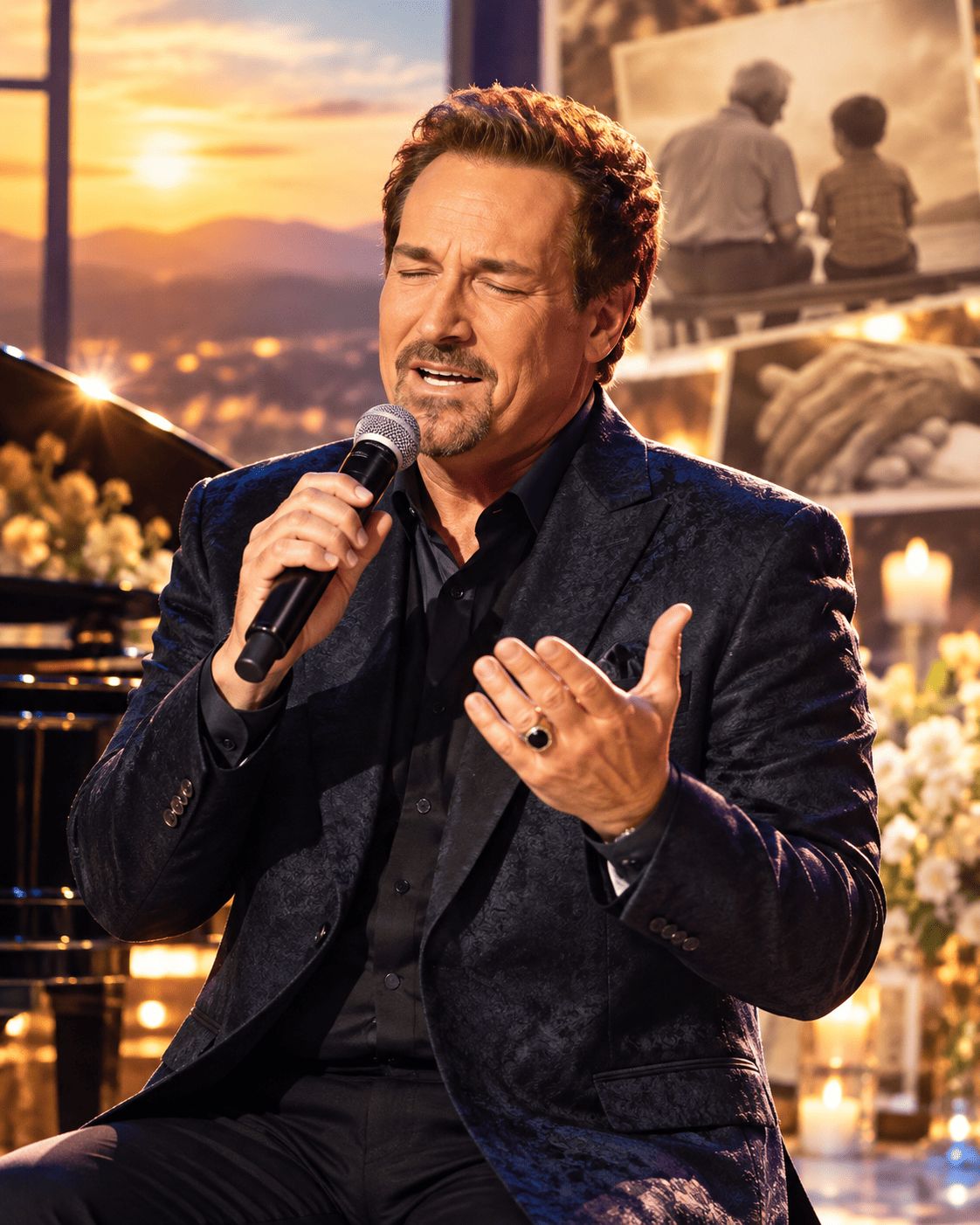
There are some songs that entertain us. And then there are songs that make us stop what we are doing because, suddenly, the words sound as though they were written for a memory we have carried for years.
Michael English’s recording of “The Living Years” belongs to that second kind.
It does not need a dramatic stage, a spectacular vocal climax, or a complicated story. It simply asks a question that becomes more meaningful with age: How many things do we leave unsaid because we believe there will always be another tomorrow?
THE CONVERSATION THAT NEVER HAPPENED
There are certain memories that seem to become clearer as the years pass.
A kitchen table.
A familiar voice from another room.
A telephone call we meant to make.
A sentence we thought we would say later.
When we are young, “later” feels almost unlimited. There will always be another Sunday, another Christmas, another birthday, another afternoon when there will finally be enough time to sit down and talk.
Then life teaches us otherwise.
That is the emotional doorway into Michael English’s version of “The Living Years.”
The song was originally recorded by Mike + The Mechanics in 1988, but English brought his own interpretation to the song on his 2017 album Love Is the Golden Rule. His official album listing places “The Living Years” as the third track, while contemporary coverage identifies it as a cover produced and arranged by Jay DeMarcus.
But simply calling it a cover does not explain why the recording can feel so personal.
Some songs arrive in your life as music.
Others arrive as memory.
MICHAEL ENGLISH LETS THE SONG CARRY THE WEIGHT
Michael English has spent decades giving Gospel and Christian music a voice that listeners recognize almost immediately.
Yet the power of this recording is not simply about vocal ability.
It is about restraint.
It is about allowing the words to breathe.
A contemporary review of Love Is the Golden Rule singled out English’s rendition of “The Living Years” and noted the emotional connection that listeners familiar with his story could hear in the performance. Another SGNScoops review described the song as reflecting English’s own relationship with his father and emphasized its message about saying what needs to be said while loved ones are still here.
That gives the performance another layer.
You are not simply listening to Michael English sing about regret.
You are hearing a seasoned artist stand inside a song about time, memory, and the things human beings sometimes struggle to say.
And that distinction matters.
Because the older we become, the less interested we tend to be in perfect performances.
We remember the moments that felt true.
A SONG FOR PEOPLE WHO HAVE LIVED A FEW MORE SEASONS
This is where “The Living Years” can speak especially strongly to a mature Gospel audience.
A younger listener may hear a song about a father and son.
Someone who has lived through several decades may hear something much larger.
They may hear their own family.
They may remember a parent whose voice they can still hear clearly.
They may think about a conversation that ended too soon.
Or perhaps they remember the opposite—a conversation they were fortunate enough to have before time closed that door.
That is one of the quiet powers of Gospel music.
It does not always need to tell us something new.
Sometimes it reminds us of something we already know but have forgotten to feel.
The song becomes a mirror.
And when Michael English sings it, that mirror seems to become even clearer.
THERE IS SOMETHING VERY GAITHER ABOUT THIS KIND OF STORY
For longtime followers of the Gaither Vocal Band and the wider Gaither musical world, Michael English occupies a special place in the history of Southern Gospel and Christian music.
His career has crossed eras, styles and generations, but the thread running through much of that music is storytelling.
Not storytelling for entertainment alone.
Storytelling as testimony.
Storytelling as remembrance.
Storytelling as a way of saying, “You are not the only one who has felt this.”
That is why a song such as “The Living Years” can sit comfortably beside the emotional tradition that longtime Gospel listeners associate with Gaither performances.
The magic is not always in the biggest note.
Sometimes it is in the silence before the next phrase.
Sometimes it is in the warmth of a supporting harmony.
Sometimes it is in the way an audience becomes completely still because everyone in the room suddenly remembers someone.
That is the extraordinary thing about a powerful live performance.
The singer may be standing under the lights.
But every person listening is carrying their own story.
THE MESSAGE IS NOT “DON’T HAVE REGRETS”
And perhaps this is where the song becomes more mature than a simple inspirational message.
It does not need to tell us that everything can be fixed.
It cannot.
There are conversations that will never happen.
There are apologies that cannot be delivered in person.
There are questions that will remain unanswered.
But there is still something we can do with the time we have now.
We can listen.
We can speak.
We can forgive.
We can call.
We can sit at the table a little longer.
We can tell someone what they mean to us without waiting for a perfect occasion.
That is not a sermon.
It is simply one of the truths that becomes clearer as the years pass.
And perhaps that is why this recording feels so close to the heart of faith.
Faith does not erase the past.
It teaches us how to carry it.
It reminds us that grace can exist even inside memories that still hurt.
And sometimes worship is not a soaring chorus in a packed auditorium.
Sometimes worship is simply gratitude for the people we were given, the conversations we did have, and the opportunity to love the people who are still sitting beside us.
THE VOICE BECOMES THE MEMORY
There is something especially moving about hearing an experienced singer interpret a song about time.
The voice itself carries history.
Michael English’s distinctive style has been part of Christian music for decades, and Love Is the Golden Rule was deliberately presented as a return to the vintage sound many longtime listeners associated with him. SGNScoops reported that the project was designed around messages of love and unity, while the album review described a strong sense of nostalgia connected with English’s earlier solo work.
That nostalgia is important.
Because nostalgia is not merely looking backward.
Sometimes it is looking backward so we can understand what matters right now.
A familiar voice can take us to another decade in a matter of seconds.
A melody can bring back a face.
A lyric can reopen a memory we thought we had put away.
And suddenly, a song recorded years ago becomes part of today’s conversation.
WHO WOULD YOU CALL?
Perhaps that is the question worth leaving with the listener.
Not: Was Michael English’s version the greatest?
Not: Did he sing it better than the original?
But something much more personal:
Who is the person you wish you had one more conversation with?
And then, perhaps an even more important question:
Who is still here waiting to hear from you?
That is where the song quietly changes from memory into possibility.
The past cannot be rewritten.
But the present still has a voice.
And perhaps that is the greatest gift hidden inside Michael English’s recording of “The Living Years.”
It reminds us that time is precious without turning the message into fear.
It reminds us of regret without making regret the final word.
It turns memory toward grace.
And it turns a familiar melody into a moment of reflection.
Some songs entertain us.
Some songs make us sing along.
But every once in a while, a song makes an entire room grow quiet because everyone is thinking about somebody.
Michael English’s “The Living Years” is that kind of song.
It asks us to remember the people who shaped us.
To honor the words we once heard.
To cherish the people still within reach.
And, perhaps most importantly, to understand that tomorrow is never something we should take for granted.
Because sometimes the most meaningful inspiration does not come from a spectacular moment on stage.
Sometimes it comes from a simple reminder:
If there is something in your heart that needs to be said, perhaps the time to say it is not someday.
Perhaps it is while you still can.